
Built to Withstand: Creating Wildfire-Prepared Homes
Moderator Casey Taylor leads a thoughtful discussion with panelists Jessica Pyska, J. Lopez, Laura Blaul, and Karl Flippinger on leadership, collaboration, and the power of partnerships in community resilience. Together, they share real-world experiences from across sectors—government, education, and emergency management—highlighting lessons learned, challenges faced, and strategies that strengthen local response and recovery efforts. This engaging conversation showcases how teamwork and shared vision drive meaningful progress in communities.
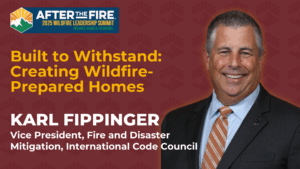 Karl Fippinger
Karl Fippinger is a senior executive leading advocacy for resilient codes and standards in the built environment with the nation’s fire service and emergency management leaders. He is a 30-year veteran of fire and emergency services having served as an Assistant Fire Chief with the Occoquan-Woodbridge-Lorton Volunteer Fire Department in Prince William County, VA as well as an adjunct instructor with the Fairfax County Fire and Rescue Department. Karl is a Certified Emergency Manager and serves as a member of FEMA’s National Advisory Council. He brings more than 25 years of public and private sector experience in federal, state, and local disaster preparedness, response, recovery, and mitigation.
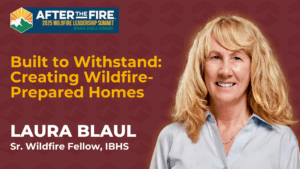 Laura Blaul
Laura is the senior Wildfire Fellow for the Insurance Institute of Building & Home Safety–IBHS, where she leads collaborative efforts to advance wildfire resilience through strategic partnerships, applied research, and community engagement. She also serves as Chair of the Board of Directors for the California Fire Safe Council, where she collaborates with public safety professionals, local governments, and residents to promote proactive wildfire mitigation. Laura is a retired fire service executive with over 30 years of experience protecting communities and advancing safety. As Assistant Chief and Fire Marshal for the Orange County Fire Authority, she led a Community Risk Reduction program that transformed compliance-driven practices into data-informed strategies focused on measurable outcomes and long-term resilience.
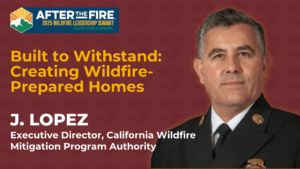 J. Lopez
J. Lopez is a retired Assistant Fire Chief with the County of Los Angeles Fire Department, Forestry Division and is the Executive Director of the California Wildfire Mitigation Program Authority. Lopez leads the implementation of the California Wildfire Home Hardening Program, bolstering community resilience against wildfires through innovative mitigation strategies that prioritize high-risk and vulnerable communities. He oversees programs that support wildfire home retrofitting, engineering mitigation solutions, vegetation management, and defensible space development. He serves on the board of directors of the California Fire Safe Council, the Cal Poly Wildland-Urban Interface Fire Institute Advisory Council, the University of California Agriculture and Natural Resources Fire Advisory Committee, and the U.S. Green Building Council Wildfire Defense Advisory Group. Mr. Lopez holds a Bachelor of Science Degree in Agricultural-Forestry Engineering.
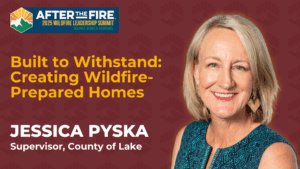 Jessica Pyska
Jessica Pyska is the supervisor for the 5th District of Lake County. Her priorities are focusing on fostering safe, resilient communities, advancing economic growth, and championing climate resiliency, disaster prevention, and preparedness. Over the past decade, Lake County has faced devastating wildfires, which have burned nearly 70% of its landscape. When the Valley Fire of 2015 destroyed her family home, Jessica immediately began rebuilding—not just her house, but her entire community. Her journey led to community organizing, working tirelessly on long-term recovery, disaster preparedness, climate resiliency initiatives, and strategic planning. Elected to the Board of Supervisors in 2020, she continues to channel her passion and expertise into creating a stronger and more sustainable future for Lake County. Jessica’s leadership has been instrumental in forging partnerships across diverse teams, including local, state, and federal agencies, tribal nations, non-profits, and community organizations, developing innovative programs that leverage collective strengths to address pressing challenges, including the impacts of climate change.