
How to Organize the Local Recovery with Block Captains / Zone Captains
Recovery after wildfire is a long and complex journey that requires collaboration and clear communication channels to tackle the ongoing challenges ahead. If the community is going to recover, it is going to require an inclusive approach that brings in wildfire survivors, local government, nonprofit organizations, and private sector/business and the larger community. It will require some honest and open conversations to constructively work on the challenges that each one of these groups must face. Everyone needs to join in the work to make the rebuild progress forward for everyone.
What is the Block Captain/Zone Captain System?
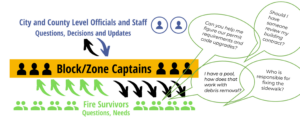
Why Organize? The work of rebuilding after wildfire is daunting, with so many homes lost or damaged, and so many people who are putting their lives back in order. Also, local government officials and staff may be stretched more than ever to deal with a new emergency workload to meet challenges they have never faced before.
The Block/Zone Captain system helps everyone move ahead more smoothly, where individual needs can be addressed while also leveraging the power of stakeholders working together. The Block Captain system has provided significant savings of ~25% to people rebuilding in the same areaboth rural and suburban areas can do this effectively. Examples of how this might help create savings of both time and money:
• Coordinated mass tree removal on private property
• Getting records or surveying done together
• Negotiating for group rates when sharing the same contractors or builders
• City staff can spend less time on the phone answering individual questions and more time reviewing permits and advancing the recovery
The first step in organizing is to look at a map of the damaged area divide it into groupings or areas. In Coffey Park, which is suburban neighborhood with >1300 structures burned, the neighborhood had 5 major areas designated, that they numbered (Area 1, Area 2, Area 3, etc.). In Paradise, a rural area, they used the already designated Evacuation Zones to draw their boundaries. Consider best for your own community how to divide and designate the groupings and give them names that are easy to remember. Then, within these areas, volunteer Block/Zone Captains sign up to represent smaller sections within their respective area. For example, in Coffey Park, Area 1 had 6 volunteer Block Captains—all were wildfire survivor rebuilders themselves, too.
The Block/Zone Captain’s role is to serve as a representative rebuilder, and a communications hub for that group of homes. They check-in with the households, listen, empathize, and help find answers to questions. They are generalists who learn about the rebuild process and share what they know or resources to seek with the households in their assigned block/zone and with the other volunteer block/zone captains too.
Each block or zone represented can create their own best way of staying connected and corresponding on all kinds of redevelopment efforts, and even choose to meet up together in person or virtually–it’s totally up to the volunteer’s capacity and the neighborhood’s own needs and situation. It helps to nurture the social connectedness for these survivors too as they work through problems together and celebrate progress too.
The Block/Zone Captains from all the area groups should meet regularly (weekly or bi-weekly) and reach out to invite city or county staff (planning department, wildfire recovery staff, etc.) to the meeting to address questions and problems. Find ways to partner with local officials for a smoother rebuild. Other invited guests-both private and public sector who are part of the recovery can help educate and inform at these meetings. And always reserve at least half of the time or more for only the Block Captain group to compare notes, make plans and address common challenges together as a group.
For the wildfire rebuilding community to be heard as one, it’s critical to have the support of both local elected officials and staff within the public sector to support this and help take issues to decision makers in the county or town to facilitate action. This system brings change from the citizens (private sector) and moves it to the officials (public sector). Your zone captain becomes your presenter to the officials (public sector) to voice your issues and get answers.
Essential Tips for Organizing
Experiencing loss from wildfire is devastating. From the personal trauma, and material loss, to the unknowns that lie ahead, it is easy to feel overwhelmed. This is why it is so valuable to connect with others and build community. Nobody can or should shoulder all of this alone. By working together and sharing your problems, you can also work together to find information and form solutions. Here are a few things to consider as you bring your community together and start to get back on your feet.
• Find people (that alone is a challenge!) and invite them to join with you and get organized to navigate recovery together.
• Recruit volunteer block/zone captains and have a dedicated communications plan for these leaders to share information. (Slack, a private forum, or other online group communications tool works well)
• Define who you are organizing and what challenge or problems you have in common (and try to define which problems are not yours to solve, too).
• Invite people to meetings/events (in person, virtual or both) both to share and to gather information.
• Create consistent communications channels to reach people effectively. Not everyone uses social media. Not everyone uses a computer. Sometimes a phone call or a post card can be effective for a block captain to reach people.
• Establish norms and guidelines for your communications channels so they can be safe places for people to share openly without fear of being attacked personally. Do this both for the block captain leadership group, and for the larger community network of wildfire survivors. Threads can get heated since this is stressful and sometimes exhausting work. Who is in the group and who is not? What kinds of content and language/behavior are allowed and appropriate for discussion in the group? Set these agreements from the beginning.
• Make sure you have created some communications channels for survivors only to share information and support one another.
• Survey people and use the results to make informed actions for where to focus your work.
• Work collaboratively with knowledge, caring, respect.
• Leverage the unique talents and abilities of volunteers to their unique, best potential. Everyone has something to contribute.
• Preserve privacy and earn trust.
• Develop avenues for advocacy to those in leadership.
• Remember that the situation is complex, and fluid and things change and evolve over time. It is a marathon, not a sprint. Adaptability is a key component of resilience.