Cross-Fire Insights
Eight years of data across fifteen fires. What the numbers show — and what they can't tell you on their own.
Rebuild Timelines — What the Data Shows
Actual certificate of occupancy (CO) counts at two, four, and six years reveal how dramatically recovery speed varies. Structure count alone does not explain the difference.
| Fire | Structures | 2 years | 4 years | 6 years |
|---|---|---|---|---|
| Tubbs (Santa Rosa) | 5,636 | 900 CofOs | 2,176 CofOs | 2,500 CofOs (~80%) |
| North Bay Complex | 8,900 | 1,240 CofOs | 3,180 CofOs | 4,600 CofOs (~75%) |
| Camp Fire (Paradise) | 18,804 | 412 CofOs | 1,820 CofOs | 3,100 CofOs (~22% pop) |
| Dixie (Greenville) | 1,311 | 48 CofOs | 145 CofOs | TBD (~18%) |
Sources: ICMA, socoemergency.org, Town of Paradise, Plumas County, Boulder County Dashboard, After the Fire USA Cross-Fire Recovery Matrix
What Accelerates Recovery and What Stalls It
Accelerators
Dedicated, parallel permitting system from day one
Public rebuild dashboard tracking every parcel
Clear compensation pathway, actively navigated
Block Captain and community leader networks
Pre-approved plans and group permit processing
Permanent, reusable recovery infrastructure
Grants for specific infrastructure barriers
Third-party plan review decoupled from standard queue
Navigation programs staffed early, community-based
Stall Factors
No published plan-check turnaround targets
Opaque or fragmented permitting process
Delayed or unclear compensation claims
Top-down-only communication
No process for collective or group applications
Ad hoc systems rebuilt from scratch each fire
Unfunded infrastructure gaps (septic, water, roads)
Aggregate-only data masking equity disparities
Waiting for Year 3 surge instead of preparing for it
Community Type: Not the Same Recovery
One of the most consequential habits in wildfire discourse is treating "fire recovery" as a single category. The terrain of recovery changes significantly based on where the fire burned and who lived there.
Urban
Suburban
Rural/RURAL RESIDENTIAL
Frontier
Max structural barriers: distance, small governance, low visibility. State-level anchoring required.
Explore Our
Cross-Fire Matrix
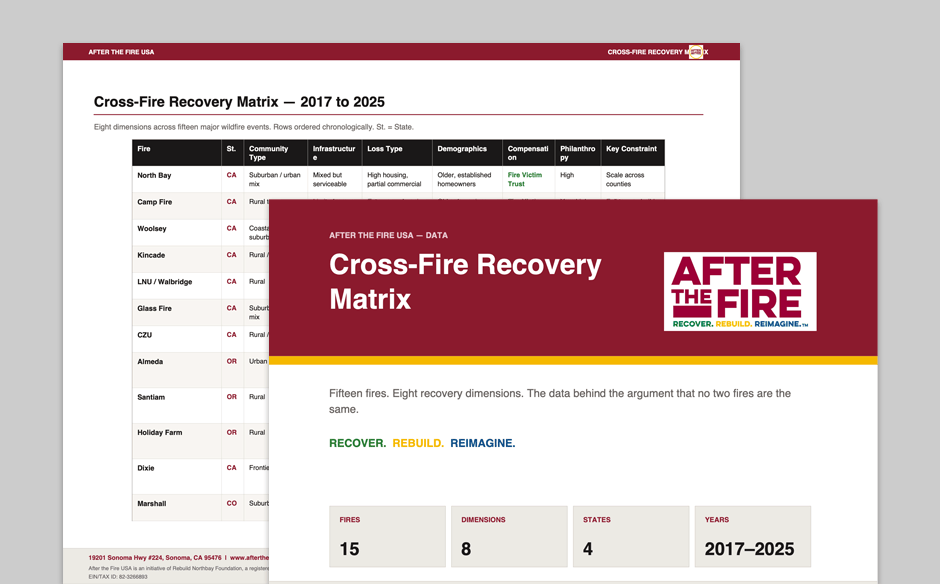
If you work in recovery planning, policy, or communications, the Cross-Fire Recovery Matrix will save you from the most common mistake in this field: assuming that structure counts predict outcomes. Across fifteen fires, nine variables, and eight years of field data, the matrix shows you exactly where the real differences lie — and where lessons actually transfer.