
To Rep. Kevin Kiley, In Response to FireAid Letter and Mischaracterization of After the Fire USA
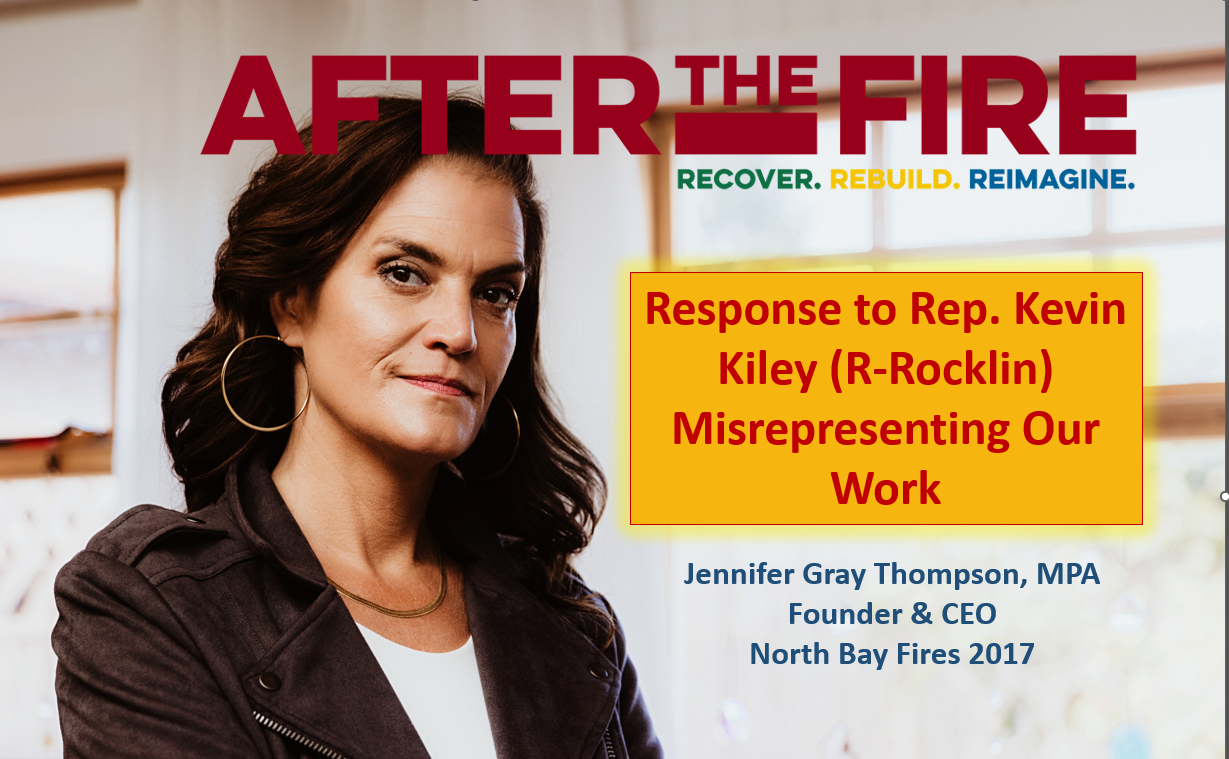
After the Fire USA responds to Rep. Kevin Kiley’s letter to the DOJ questioning wildfire recovery funding. We correct the record, highlight our survivor-centered impact, and call for bipartisan focus on recovery.
The Honorable Kevin Kiley
U.S. House of Representatives
Washington, D.C.
Re: Response to FireAid Letter and Mischaracterization of After the Fire USA
Dear Representative Kiley,
I am writing on behalf of After the Fire USA, in my role as Founder and CEO, to address your recent letter to the Department of Justice concerning FireAid and the nonprofits that received funding to support recovery from the devastating January 2025 wildfires in Los Angeles.
While I appreciate and share your commitment to protecting donor intent and public trust, your letter contains critical inaccuracies that risk undermining survivor trust and the very recovery efforts your constituents and others depend upon.
Most troublingly, your remarks dismiss the leadership, expertise, and lived experience that our team and partners bring to traumatized communities. To date, no evidence has emerged of wrongdoing, and in our experience, FireAid has acted with integrity and humility—often to the point of invisibility. If I have any criticism, it’s that they didn’t ask for any credit, which led to an unfortunate lack of awareness of their deep impact. Their discretion was rooted in respect for survivors, not the intent to deceive.
Let me be clear: After the Fire USA did receive a FireAid grant to provide strategic, survivor-centered recovery services following the Los Angeles fires. We are proud of the work those funds enabled. A full report on our FireAid-supported services is attached.
After the Fire USA is the only nonprofit in the nation solely dedicated to megafire recovery. We are also the leading national advocate for fire survivors and wildfire recovery policy. In 2022, I was honored to be recognized by Forbes as one of the 50 over 50 most impactful women in America for my work in this field. That recognition, however, pales in comparison to the gratitude we’ve received from survivors themselves — because that is who we serve first, last, and always.
As we have done in virtually every megafire community in the United States, we provided strategic coaching, systems navigation, stakeholder convening, and technical support to help communities access resources, build long-term recovery systems, and ultimately heal. Our motto is simple: no one goes it alone.
You referenced that we are based in Sonoma County, implying a disconnect from Los Angeles. That misunderstands both our work and our origin story. We are headquartered in Sonoma because that’s where this modern megafire crisis began. I watched my hometown burn from all sides in 2017, losing 43 lives and more than 8,900 structures across four counties. In those terrifying days, I witnessed a profound resilience and community strength that would go on to shape everything we do.
Unfortunately, we quickly discovered that our systems were unprepared for megafire disasters of this magnitude. That realization forged a promise: no community would ever walk this path alone again.
From that promise, After the Fire USA was born.
Since then, I’ve spoken at FEMA, HUD, SBA, testified before the U.S. Senate, and presented at institutions including MIT and UNC. I’ve worked across party lines to help pass landmark federal legislation, including H.R. 5863, which delivered essential tax relief for survivors. We’ve supported recovery efforts in your own district and others. I’ve communicated directly with your office and staff regarding urgent needs in Plumas County post-Dixie Fire.
Here’s a snapshot of the megafires where After the Fire USA has supported recovery:
California:
- 2017 North Bay Fires – Sonoma, Napa, Lake, Mendocino Counties
- 2018 Camp Fire – Butte County
- 2018 Woolsey Fire – Los Angeles County
- 2019 Kincade and Walbridge Fires – Sonoma County
- 2020 Glass (Sonoma County) and CZU Lightning Complex Fires (Santa Cruz)
- 2021 Cache (Lake County) and Dixie Fires (Plumas County)
- 2025 Los Angeles Fires – Palisades and Eaton Fires
Oregon, Colorado, Hawaii:
- 2020 Almeda, Santiam Canyon, McKenzie Fires
- 2021 Marshall Fire – Boulder County
- 2023 Maui Fires – Lahaina and Kula
In Los Angeles, we responded to community requests with:
- Six delegations of expert practitioners and survivor-leaders
- Two block captain systems, co-designed with local leaders
- 30+ public and private webinars on mental health, FEMA/SBA processes, insurance, recovery financing, and storytelling
- Strategic advising for clergy, civil servants, and local organizers
- Briefings with funders for accessible and innovative resource deployment
- Policy memos, technical working groups, and disaster finance translation for public use
- Over 1,000 meetings with stakeholders, survivors, and local leaders—virtually and in-person—to keep the work moving forward between site visits
We continue to be on the ground in Los Angeles, bringing delegations monthly and supporting communities virtually the rest of the time. Recovery is not a moment; it is a movement—and we show up for it.
We are proud to be of service to the people of Los Angeles. Our work is guided by deeply experienced leaders like Reva Feldman (Woolsey Fire, 2018) and Valerie Brown (Witch Creek Fire, 2007), with support from committed staff like Natalie Minuzzo. This is not just our work. It’s our mission.
Let me also directly address the notion that we are politically motivated. Our D.C. work is bipartisan, consistent, and deeply rooted in the needs of survivors. I’ve met with offices on both sides of the aisle, including yours, to advocate for fair and trauma-informed recovery. Notably, we supported tax relief efforts alongside Rep. Doug LaMalfa (R-Butte), Rep. Mike Thompson (D-Napa), and yourself.
Megafire doesn’t care about party lines, and neither do we. We walk into disaster zones as fellow Americans. We offer technical expertise, yes—but also hope and humanity. Nonpartisanship is not neutrality. It’s the basis of durable partnership.
Your office has seen our tireless efforts and legislative wins. I’ve exchanged several emails with your Chief of Staff, Bob Holste, who once told me:
“Keep your head down, don’t get discouraged and keep pushing. […] Keep up the good work and God speed.”
That message meant a great deal to me. Which is why your public attack came as a disappointment.
My team will be in Greenville this week, revisiting recovery work in the Dixie, Camp, and CZU fire zones. While I won’t be there personally this time, I’ve made the trip many times before. I know those roads. I know the people. There’s still a crack in my truck’s windshield and a nail in my back tire from one of those trips.
I invite you to join them. Walk the roads of a town your constituents are rebuilding with grit and grace. Revisit what survivor-led recovery looks like on the ground. Let’s talk story at The Spot, marvel at Ken Donnell’s rebuilds, or meet with Sierra Institute. Let’s refocus on what really matters.
In closing, I offer a quote from Nick Cave that has stayed with me:
“Cynicism is not a neutral position—and although it asks almost nothing of us, it is highly infectious and unbelievably destructive. […] Hopefulness is not a neutral position either. It is adversarial. It is the warrior emotion that can lay waste to cynicism.”
We work in devastation. We show up with skill, heart, and humility. We choose hope. And we’ll continue to walk that path with every fire survivor who needs us.
Let’s move forward with clarity and shared purpose. Fire survivors deserve nothing less.
Sincerely,
Jennifer Gray Thompson, MPA
Founder & CEO